
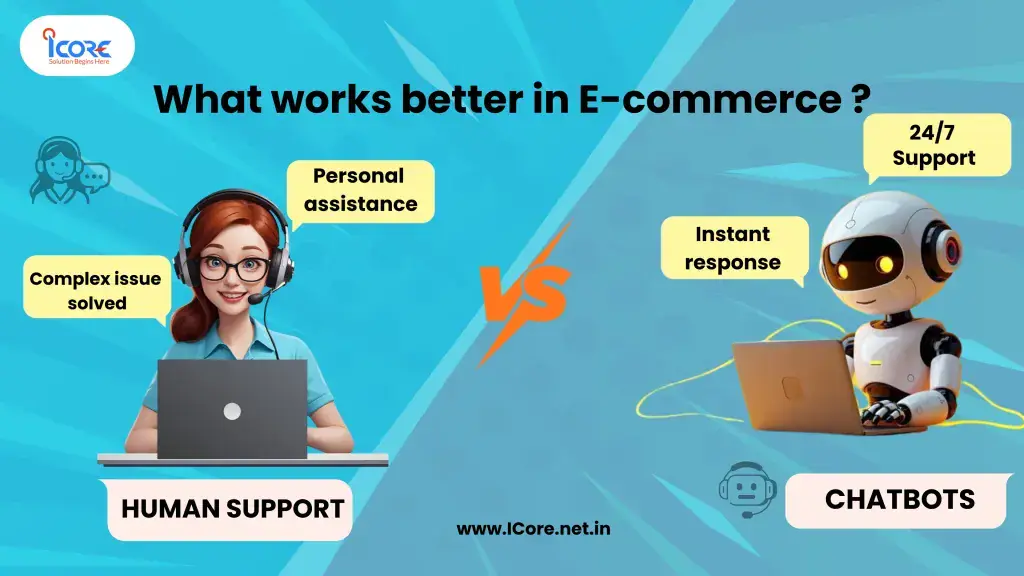
Chatbots Vs Human Support: What Works Better in E-commerce?
Related Insights



Key Takeaways
- •Best-in-class AI chatbots achieve 70-80% containment; average deployments reach 40-55%.
- •75-82% of customers prefer chatbots for routine inquiries; 85% want a human for complaints.
- •AI handles a routine interaction for roughly Rs.40-60 versus Rs.500-1,250 for a human.
- •Hybrid routing produces the highest satisfaction (~89%) versus pure AI alone (~74%).
- •Training a chatbot on real business data is what separates high and low containment rates.
Chatbots Vs Human Support: What Works Better in E-commerce?
Best-in-class AI chatbots now contain 70-80% of customer conversations without human escalation, and AI handles an interaction for roughly ₹40-60 ($0.50-0.70) versus ₹500-1,250 ($6-15) for a human agent. But 85% of customers still want a human specifically for complaints, and 72% prefer one for genuinely complex issues. The real answer isn't chatbots versus humans — it's knowing exactly which conversations belong to which.
Key Takeaways
- Best-in-class AI chatbots achieve 70-80% containment (resolving queries without human escalation); average deployments reach only 40-55%.
- For routine inquiries like order tracking and FAQs, 75-82% of customers actually prefer chatbots for the instant response time.
- For complex issues, 72% prefer a human; for complaints specifically, that rises to 85%.
- AI handles a routine interaction for roughly ₹40-60 versus ₹500-1,250 for a human agent — a meaningful cost gap at scale.
- Hybrid approaches, routing intelligently between AI triage and human escalation, produce the highest customer satisfaction (~89%) compared to pure AI alone (~74%).
What "Chatbots Vs Human Support" Actually Means
This isn't a competition with one winner — it's a routing problem. Different types of customer queries genuinely warrant different handling: a simple order-status question and an angry complaint about a damaged product are not the same interaction, and treating them identically with either all-chatbot or all-human support wastes resources or frustrates customers, sometimes both at once.
What It Looks Like When It's Working
Scenario: A Coimbatore e-commerce business selling home goods was routing 100% of customer messages to a small human support team, who were overwhelmed with repetitive order-tracking and return-policy questions, leaving genuinely complex complaints waiting hours for a response. After deploying an AI chatbot trained specifically on their order data and policies, with automatic escalation to a human for anything flagged as a complaint or unresolved after two exchanges, containment reached roughly 65% within a month.
Average response time for complex issues dropped from several hours to under 20 minutes, since the support team was no longer buried in routine questions — and customer satisfaction scores rose specifically on the complaint-handling side, consistent with the broader pattern where hybrid routing outperforms either pure approach.
How to Decide What to Automate
Step 1: Categorize your support volume by query type
Pull three months of support data and bucket it — order status, returns/refunds, product questions, complaints, complex technical issues — before deciding what to automate.
Step 2: Automate the highest-volume, lowest-complexity categories first
Order tracking, basic FAQs, and return policy questions are exactly where the 75-82% chatbot preference and highest containment rates apply — the clearest starting point for automation.
Step 3: Build explicit escalation rules for complaints and complex issues
Given 85% of customers want a human for complaints, route these immediately rather than forcing them through a bot first — a frustrated customer stuck in a chatbot loop does real reputational damage.
Step 4: Train the chatbot on your actual data, not generic scripts
A chatbot connected to real order status, inventory, and policy data resolves far more queries genuinely than one running on static, generic scripts — this is the difference between 40-55% average containment and 70-80% best-in-class containment.
Step 5: Monitor and adjust the automation-to-human ratio over time
Track containment rate, escalation rate, and satisfaction by category regularly — the right balance shifts as your product line, customer base, and chatbot training data mature.
Common Challenges and How to Overcome Them
"Customers get frustrated with our chatbot and want a human immediately."
Check whether complaint-type queries are being routed to the bot first — given 85% of customers want a human for complaints specifically, this category should escalate immediately, not after a failed bot attempt.
"Our containment rate is much lower than the benchmarks."
This usually means the bot isn't connected to real data — a generic script-based bot tops out around 35%, while one trained on live order and policy data can reach 70-80%.
"We're worried automating support will hurt customer relationships."
The data suggests the opposite when done well — freeing human agents from repetitive queries lets them spend more attention on the complex and complaint interactions where a human genuinely matters most.
Where Smaller Businesses Have an Advantage
- A smaller support volume makes it realistic to properly categorize and understand query patterns before automating, rather than guessing at scale.
- Closer connection between the support team and the business means escalation rules can be tuned quickly based on real, direct feedback.
How This Connects with Other Business Decisions
Support automation ties directly into overall AI development strategy (a properly trained support bot follows the same principles as any custom AI implementation), customer retention (fast resolution on complaints directly affects repeat purchase behavior), and operational cost structure at scale.
Best Practices for Chatbots vs Human Support
- Automate high-volume, low-complexity queries first; route complaints and complex issues to humans immediately.
- Train chatbots on real, live business data rather than static generic scripts.
- Set clear escalation triggers (unresolved after N exchanges, negative sentiment detected) rather than leaving it purely to customer request.
- Track containment, escalation, and satisfaction by query category, not as one blended metric.
- Treat the automation ratio as something to tune continuously, not a one-time setup decision.
FAQs
Should an e-commerce business fully automate customer support?
No — hybrid routing that keeps humans available for complaints and complex issues consistently outperforms pure automation on customer satisfaction.
What kinds of queries are safe to automate first?
Order tracking, FAQs, and basic policy questions — the categories where customers actually prefer the instant response of a chatbot.
How much does a chatbot actually save compared to human support?
Roughly ₹40-60 per interaction versus ₹500-1,250 for a human agent, though the real value is in freeing human capacity for higher-value conversations, not pure cost replacement.
What's the biggest risk of getting chatbot deployment wrong?
Routing complaints or complex issues to a poorly trained bot, which frustrates exactly the customers who most need a human, causing more damage than having no automation at all.
Conclusion
Chatbots and human support aren't competitors — they're complementary tools that work best when routed deliberately by query type. Businesses seeing the highest satisfaction scores are the ones automating what customers genuinely prefer automated, and keeping humans exactly where customers still want them: complaints and complexity.
If you want help designing a chatbot and support routing strategy for your business, get in touch for a straightforward review.
Share it with your colleagues and social network.