
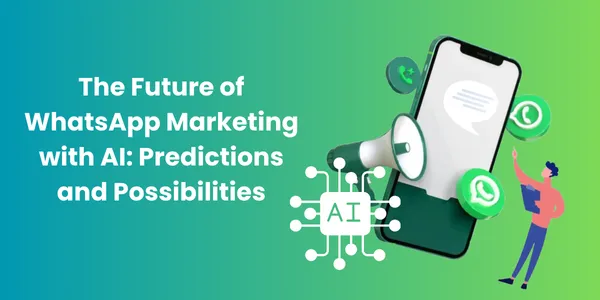
The Future of WhatsApp Marketing: How AI Is Changing Business Messaging
Related Insights


Key Takeaways
- •Generative AI WhatsApp bots resolve 74% of customer inquiries with zero human escalation, nearly double the 41% resolution rate of older rule-based chatbots, per 2026 analysis of WhatsApp conversational AI deployments.
- •WhatsApp has grown 180% as a chatbot channel, and 53% of retailers now automate at least part of their messaging on the WhatsApp Business Platform.
- •83% of businesses using WhatsApp chatbots report improved customer satisfaction, up from 70% just a year earlier, reflecting how much better AI-driven responses have gotten.
- •India leads global WhatsApp Business adoption with roughly 15 million active business accounts and 78% of Indian SMBs already using the platform for business purposes.
- •Unilever's AI-powered WhatsApp chatbot campaign drove 138% higher sales, and Nivea's WhatsApp chatbot campaign reached 207% of its original target, both real-world examples of what AI-driven messaging can move.
- •91% of medium-to-large businesses already use chatbots in some form, while 64% of small businesses plan to adopt one by the end of 2026, meaning the gap between small and large business capability is closing fast.
The Future of WhatsApp Marketing: How AI Is Changing Business Messaging
Over 200 million businesses now use WhatsApp Business worldwide, and 175 million people message a business account on the platform every single day, according to Meta's own WhatsApp Business Platform figures. In India specifically, roughly 15 million businesses have active WhatsApp Business accounts and 78% of Indian small and medium businesses already use WhatsApp in some form for sales or support. WhatsApp marketing itself is not new territory anymore.
What is genuinely new is what's happening inside those conversations. Generative AI-powered WhatsApp bots are now resolving 74% of customer inquiries without any human stepping in at all, compared to just 41% for the older rule-based chatbots most businesses were using two or three years ago. That's not a small upgrade, it's a different category of tool, and it's changing what a WhatsApp number can actually do for a business that has neither a call center nor a big marketing team.
Key Takeaways
- Generative AI WhatsApp bots resolve 74% of customer inquiries with zero human escalation, nearly double the 41% resolution rate of older rule-based chatbots, per 2026 analysis of WhatsApp conversational AI deployments.
- WhatsApp has grown 180% as a chatbot channel, and 53% of retailers now automate at least part of their messaging on the WhatsApp Business Platform.
- 83% of businesses using WhatsApp chatbots report improved customer satisfaction, up from 70% just a year earlier, reflecting how much better AI-driven responses have gotten.
- India leads global WhatsApp Business adoption with roughly 15 million active business accounts and 78% of Indian SMBs already using the platform for business purposes.
- Unilever's AI-powered WhatsApp chatbot campaign drove 138% higher sales, and Nivea's WhatsApp chatbot campaign reached 207% of its original target, both real-world examples of what AI-driven messaging can move.
- 91% of medium-to-large businesses already use chatbots in some form, while 64% of small businesses plan to adopt one by the end of 2026, meaning the gap between small and large business capability is closing fast.
What "AI in WhatsApp Marketing" Actually Means
For most of WhatsApp marketing's history, "automation" meant a decision-tree bot: press 1 for sales, press 2 for support, and if your question didn't match a pre-written option, you got stuck or got forwarded to a human. AI-driven WhatsApp marketing replaces that tree with a model that actually reads what the customer typed, understands the intent behind it even if it's phrased oddly or in Tamil-English mix, and responds in natural language, pulls in your catalog, checks order status, or books an appointment, without a human needing to be online.
This isn't a single feature so much as three things working together: the WhatsApp Business Platform (formerly the WhatsApp Business API) that lets a business send and receive messages at scale, an AI layer on top that understands and generates responses, and integrations that connect that AI layer to your actual order, inventory, or booking systems so it isn't just chatting, it's doing.
What It Looks Like When It's Working
Scenario: A Coimbatore-based home furnishings and curtain fabric retailer with two physical showrooms used to run WhatsApp purely manually, with two staff members switching between the till and replying to customer messages about fabric availability, pricing, and order status. Response times during busy hours stretched past two hours, and the owner estimated they were losing a noticeable share of enquiries to competitors who replied faster.
After setting up an AI-assisted WhatsApp Business Platform integration connected to their inventory sheet, the bot began answering fabric availability and pricing questions instantly, sending catalog images automatically, and only escalating to a human for custom orders or price negotiation. Average first-response time dropped from over two hours to under a minute. Monthly WhatsApp-driven orders rose from around ₹3.8 lakh to roughly ₹6.1 lakh within five months, and the two staff members previously stuck answering repetitive questions were freed up to handle the custom-order conversations that actually needed a human touch.
Where WhatsApp Marketing Is Headed as AI Takes Over
Conversational Commerce Replaces the "Browse and Click" Funnel
Instead of driving customers from an ad to a website to a cart, more businesses are letting the entire purchase happen inside a WhatsApp thread, catalog browsing, questions, price confirmation, and payment link, all in one conversation, which matters given that 53% of retailers already automate WhatsApp messaging in some form.
AI Handles the First 70-80% of Every Conversation
With generative AI bots now resolving 74% of inquiries without escalation, the realistic expectation for most businesses isn't "replace your support team with AI," it's "let AI clear the repetitive questions so your team only handles the ones that need judgment."
Personalization Moves From Broadcast Lists to Real One-to-One
Older WhatsApp marketing meant sending the same broadcast to everyone on a list. AI-driven messaging can reference a specific customer's past orders or browsing history within the conversation itself, which is a large part of why satisfaction scores have climbed to 83% among businesses using AI chatbots, up from 70%.
Voice Notes and Multilingual Replies Become Standard
Newer AI models handle voice-note transcription and can reply fluently across English, Hindi, Tamil, and code-mixed messages, which matters enormously for a market like Tamil Nadu where customers switch languages mid-conversation without thinking about it.
Proactive Messaging Replaces Reactive-Only Support
Instead of only answering when a customer writes in, AI-integrated systems can trigger a message when a cart is abandoned, a service is due, or stock the customer asked about earlier comes back in, moving WhatsApp from a support channel toward an active sales channel.
Small Businesses Get Enterprise-Grade Response Times
Given that 64% of small businesses plan to adopt a chatbot by the end of 2026, the response-time gap between a two-person shop and a large retailer is shrinking fast, because the AI layer, not headcount, is what determines how quickly a customer gets answered.
Catalog and Payments Integration Tightens
WhatsApp's own catalog and payment features are becoming more central to how AI bots close a sale end-to-end, cutting out the extra step of sending a customer to a separate website or payment gateway link.
Common Challenges and How to Overcome Them
"Customers hate talking to bots, they want a real person."
This was truer with rule-based bots than it is with generative AI ones. The 83% satisfaction figure among businesses using AI chatbots suggests the objection is fading, but it still helps to make escalation to a human fast and obvious rather than hiding it behind menus.
"We don't have the technical setup to connect AI to our systems."
This is where most Coimbatore businesses actually get stuck, not on the AI itself but on connecting it to inventory, booking, or order systems that were never built to talk to anything else. This is solvable with the right integration partner, but it does need to be planned rather than bolted on.
"We tried WhatsApp broadcasts before and got blocked or ignored."
Broadcast-heavy, unsolicited messaging is exactly what damages a WhatsApp Business account's quality rating and gets numbers restricted. AI-driven conversational messaging, triggered by actual customer interest rather than mass broadcasts, avoids this because it responds to opt-in behavior instead of pushing unsolicited volume.
Where Coimbatore Businesses Have an Advantage
- WhatsApp is already the default communication channel for most local customers, so there's no adoption curve to fight, the behavior is already there and just needs a better system behind it.
- Smaller operations can roll out an AI-integrated WhatsApp setup in weeks, without the layers of internal approval and legacy systems that slow this down at larger companies.
- Local, bilingual customer relationships give Coimbatore businesses a real edge in training AI responses that sound natural in the Tamil-English mix customers actually use, something a generic national chatbot script rarely gets right.
How WhatsApp Marketing AI Connects with Other Business Strategies
An AI-driven WhatsApp setup works best when it's feeding data back into the rest of your marketing rather than sitting in isolation, order patterns from WhatsApp conversations can sharpen your ad targeting, and the same catalog and pricing consistency that makes a good WhatsApp bot also strengthens your broader WhatsApp marketing strategy across broadcasts, catalogs, and customer support, so it's worth treating this as one connected system rather than a bolt-on chatbot.
Best Practices for AI-Driven WhatsApp Marketing
- Start with your most repetitive customer questions, availability, pricing, order status, and let AI handle those first before expanding scope.
- Keep a visible, fast path to a human agent for anything involving complaints, custom pricing, or complex requests.
- Connect the AI layer to real inventory or booking data so answers are accurate, not just conversational.
- Monitor conversation logs regularly in the first few months to catch and correct wrong or awkward AI responses early.
- Never use AI messaging to send unsolicited bulk broadcasts, it will damage your account quality rating regardless of how good the AI sounds.
FAQs
Do I need the official WhatsApp Business API to use AI messaging?
Yes, for any meaningful automation you need the WhatsApp Business Platform (the official API), not the free WhatsApp Business app, since the app doesn't support the integrations that AI tools need to connect to.
Will an AI chatbot replace my WhatsApp support staff entirely?
Unlikely, and it shouldn't be the goal. With AI resolving around 74% of inquiries without escalation, the realistic outcome is your existing staff handling far fewer repetitive questions and far more of the conversations that actually need a person.
Is AI WhatsApp messaging expensive to set up for a small business?
Costs vary by conversation volume and the complexity of the systems you're connecting it to, but with 64% of small businesses planning adoption by the end of 2026, pricing has come down enough that it's no longer only accessible to large retailers.
How long does it take to set up an AI-integrated WhatsApp system?
A focused setup connected to your catalog or order system typically takes a few weeks from planning to launch, though the timeline depends heavily on how ready your underlying data (inventory, pricing, booking) is to be connected.
Conclusion
WhatsApp marketing isn't becoming obsolete, it's becoming the front door to an AI-driven customer experience that businesses without a big support team can now actually afford. The gap between how a large retailer responds to customers and how a small Coimbatore business responds is closing, and it's closing because of what's running behind the WhatsApp number, not the size of the team behind it.
If your business is still answering every WhatsApp message manually, or your current setup is just a broadcast list with no real automation behind it, there's a lot of ground to gain here quickly. Get in touch and we'll help you figure out what an AI-integrated WhatsApp setup should actually look like for your business.
Share it with your colleagues and social network.