
Freelance Web Designer vs Company: Which Is Better for Your Business?
Related Insights




Key Takeaways
- •Freelancers in India commonly charge ₹500-2,000/hour or ₹15,000-80,000 for a full small business website, per 2026 Indian market pricing data.
- •Agencies typically charge ₹80,000-3,00,000 for comparable scope, with the premium covering project management, QA, and multiple specialists rather than just "markup."
- •Cost volatility in the Indian freelance market is unusually high — you can find template-based "freelancers" quoting ₹5,000 alongside skilled independents charging agency-comparable rates for custom work.
- •Agencies generally provide structured revision cycles and post-launch support built into the contract; freelancer reliability varies far more by individual, since a single-person business has no backup if they get sick, get busy, or disappear mid-project.
- •Local SEO and website-driven leads return roughly ₹13 for every ₹1 invested when the underlying site is built well, according to aggregated SEO ROI research — a number that depends heavily on the site actually functioning properly, which is where the freelancer-vs-agency decision has real downstream stakes.
Freelance Web Designer vs Company: Which Is Better for Your Business?
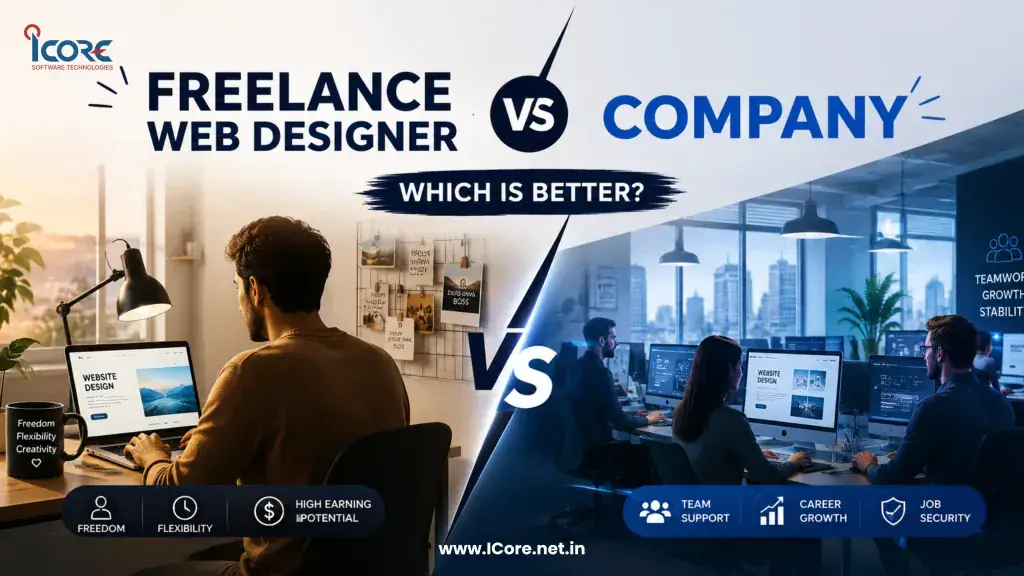
In India's current market, a freelance web designer typically charges ₹500 to ₹2,000 an hour, or roughly ₹15,000 to ₹80,000 for a complete small business website, while an agency handling the same scope charges ₹80,000 to ₹3,00,000 — a gap wide enough that plenty of business owners default to the cheaper option without weighing what that price difference is actually paying for.
Neither option is universally "better." The right call depends on your project's complexity, your timeline, and how much post-launch reliability you actually need. Here's an honest breakdown of what each option really delivers, using real Indian market pricing.
Key Takeaways
- Freelancers in India commonly charge ₹500-2,000/hour or ₹15,000-80,000 for a full small business website, per 2026 Indian market pricing data.
- Agencies typically charge ₹80,000-3,00,000 for comparable scope, with the premium covering project management, QA, and multiple specialists rather than just "markup."
- Cost volatility in the Indian freelance market is unusually high — you can find template-based "freelancers" quoting ₹5,000 alongside skilled independents charging agency-comparable rates for custom work.
- Agencies generally provide structured revision cycles and post-launch support built into the contract; freelancer reliability varies far more by individual, since a single-person business has no backup if they get sick, get busy, or disappear mid-project.
- Local SEO and website-driven leads return roughly ₹13 for every ₹1 invested when the underlying site is built well, according to aggregated SEO ROI research — a number that depends heavily on the site actually functioning properly, which is where the freelancer-vs-agency decision has real downstream stakes.
What "Freelancer vs Company" Actually Means
A freelance web designer is typically one person (sometimes two working loosely together) handling your entire project — design, development, and often content and basic SEO too. A web design company is a team with defined roles: a project manager, a designer, a developer, and often a QA or SEO specialist, working through a structured process with contracts, milestones, and support agreements.
The real difference isn't skill level — there are excellent freelancers and mediocre agencies, and the reverse. The real difference is structure: what happens if something goes wrong, who's accountable for it, and whether the business survives a single person being unavailable.
What It Looks Like When It's Working
Scenario: A Coimbatore textile trading business needed a new website with a product catalog, an enquiry system, and multilingual content. They initially hired a freelancer for ₹28,000 who delivered a visually decent site in three weeks, but six months later the freelancer had moved to a full-time job and stopped responding to messages about a broken contact form — a bug that had been silently losing enquiries for close to two months before anyone noticed.
They then engaged an agency for ₹1,40,000 to rebuild the site properly, with a signed support agreement covering bug fixes for 12 months. The higher upfront cost included a working analytics setup that flagged form issues automatically, and over the following year the business recovered from roughly 40% of paid ad clicks silently bouncing off broken pages to a functioning enquiry pipeline generating around 25 qualified leads a month. The lesson wasn't "freelancers are bad" — it was that the ₹28,000 project had no accountability built in once the freelancer moved on.
How to Decide Between a Freelancer and a Company
Match the choice to project complexity
A simple brochure-style website with five to seven pages is well within a good freelancer's comfort zone; a site needing e-commerce, custom integrations, or ongoing content management is where a team's division of labor starts to matter more.
Weigh your tolerance for single-point-of-failure risk
If your one freelancer gets sick, takes another job, or becomes unresponsive mid-project, there's no backup — a company has redundancy built in, even if it costs more, because someone else on the team can pick up where another left off.
Ask specifically what happens after launch
Get a written answer to "what happens if something breaks three months from now" before signing with either option — a freelancer without a support retainer and an agency without a clear SLA can both leave you stranded, just for different reasons.
Compare quoted timelines against realistic capacity
A freelancer juggling multiple clients alone often quotes an optimistic timeline that slips because the project genuinely can't be their only priority; a team-based agency can usually absorb one person being pulled away without the whole project stalling.
Check portfolio work for functional depth, not just visual polish
Ask to see a live site the person or company actually built, then test its contact form, load speed, and mobile version yourself — a polished screenshot says nothing about whether the underlying site actually works reliably.
Get itemized pricing, not a single flat number
Ask exactly what's included — design, development, content, SEO setup, revision rounds, hosting setup — from both a freelancer and an agency, since a low freelancer quote missing half these items can end up costing more once you pay separately for what wasn't included.
Consider a hybrid: an agency for build, direct relationship for small updates
Some businesses use an agency for the initial build (where structure and reliability matter most) and a trusted freelancer for small ongoing content updates afterward — getting the best of both without paying agency rates for minor tweaks indefinitely.
Cost Comparison: Freelancer vs Agency (India, 2026)
| Factor | Freelancer | Agency |
|---|---|---|
| Typical hourly rate | ₹500-2,000 | ₹2,000-3,000+ |
| Small business website (full project) | ₹15,000-80,000 | ₹80,000-3,00,000 |
| Team structure | Usually one person | Multiple specialists (design, dev, QA, PM) |
| Post-launch support | Varies widely, often informal | Usually contracted, with an SLA |
| Risk if the point of contact becomes unavailable | High — project can stall entirely | Lower — team can reassign work |
| Best fit | Simple sites, tight budgets, fast turnaround | Complex builds, long-term reliability needs |
Common Challenges and How to Overcome Them
"The freelancer quote was so much cheaper, why would I pay agency prices?"
Get an itemized breakdown of exactly what the freelancer's quote includes — many low quotes exclude revisions, SEO setup, or post-launch support that you'll end up paying for separately, closing much of the price gap.
"We got a bad agency experience and switched to freelancers to save money."
A single bad agency experience doesn't mean all agencies operate the same way — check for a specific, written support agreement and real client references before switching entirely to a lower-structure option.
"Our freelancer disappeared mid-project and we don't know what to do."
Get whatever source files and access credentials exist immediately, then have a second developer or agency assess what's actually been built before deciding whether to continue or rebuild — this is unfortunately common enough that it's worth planning for upfront with any freelancer engagement.
Where Coimbatore Businesses Have an Advantage
- A smaller, more relationship-driven business community makes it easier to get honest references on both freelancers and agencies before committing.
- Lower overhead costs in Coimbatore compared to metro cities mean agency-quality work is often available at meaningfully lower prices than the same team structure would cost in Bangalore or Chennai.
How This Decision Connects with Other Business Strategies
Your website choice directly affects every other digital investment downstream — a site built without SEO fundamentals in mind undercuts your organic search potential from day one, and a site that isn't genuinely fast or reliable wastes a portion of every rupee spent on paid advertising driving traffic to it, which is why website speed and reliability deserve real weight in this decision, not just design aesthetics.
Best Practices When Choosing Either Option
- Always get a written scope of work listing exactly what's included before paying anything.
- Test a live example of past work yourself — load speed, mobile view, and contact form — rather than trusting screenshots alone.
- Clarify post-launch support terms in writing before the project starts, not after something breaks.
- Match your choice to actual project complexity rather than defaulting to whichever option is cheapest upfront.
- Keep a backup contact or documentation of your site's technical details regardless of which option you choose.
FAQs
Is a freelancer always cheaper than an agency in India?
Usually for the upfront quote, yes, but the total cost gap narrows once you account for what a low freelancer quote often excludes — revisions, SEO setup, and post-launch support — which many agency quotes bundle in from the start.
What's the biggest risk of hiring a freelancer for a business website?
Single-point-of-failure risk — if that one person becomes unavailable, your project or your post-launch support can stall with no built-in backup, unlike a team-based agency.
When does it make sense to choose an agency over a freelancer?
When your project involves e-commerce, multiple integrations, ongoing content needs, or when long-term reliability and accountability matter more to your business than minimizing the upfront cost.
Can I switch from a freelancer to an agency later if needed?
Yes, though get whatever source files and technical access exist first — a competent agency can usually take over an existing freelancer-built site, though a full rebuild is sometimes more cost-effective than patching one built without proper structure.
Conclusion
There's no universally correct answer between a freelancer and a company — the right choice depends on your project's complexity, how much post-launch reliability your business genuinely needs, and how much single-point-of-failure risk you're comfortable carrying. What matters most is going in with a clear, written scope and realistic expectations either way.
If you'd like an honest assessment of what your specific project actually needs before you commit either way, get in touch for a review.
Share it with your colleagues and social network.