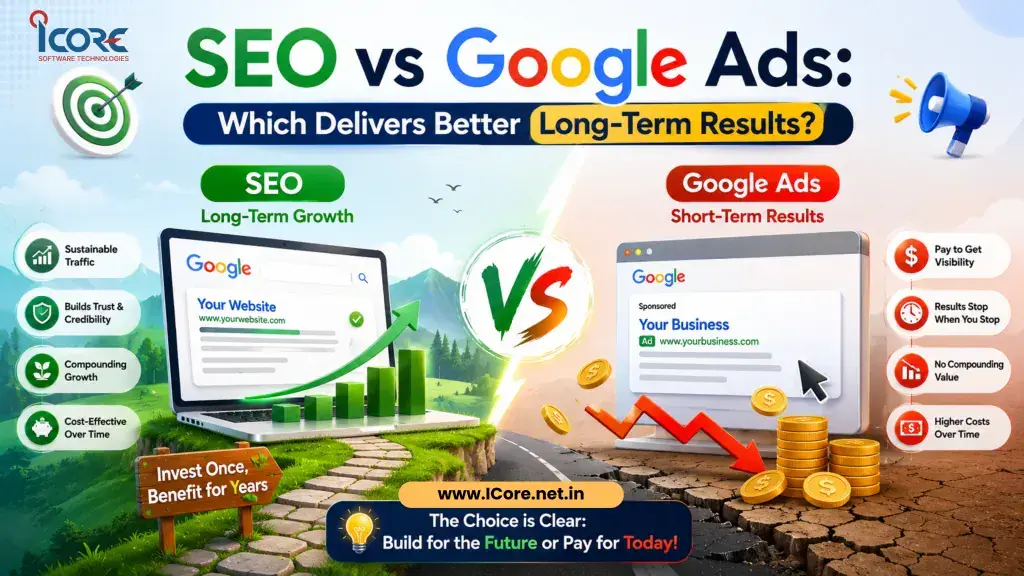
SEO vs Google Ads: Which Delivers Better Long-Term Results?

Key Takeaways
- •SEO-driven leads close at roughly 14.6% versus 1.7% for outbound leads.
- •Organic search drives roughly 53% of all website traffic industry-wide.
- •Google Ads delivers traffic immediately but stops when spend stops; SEO compounds over months.
- •Average Google Ads CPC in India runs around Rs.24 for Search, ranging Rs.15-460+ by industry.
- •The best approach for most businesses combines both rather than choosing one exclusively.
SEO vs Google Ads: Which Delivers Better Long-Term Results?
SEO-generated leads close at roughly 14.6%, compared to 1.7% for outbound and cold-outreach leads — a gap wide enough to change how you think about where marketing budget should go. But that doesn't make Google Ads worthless; it makes the two tools fundamentally different instruments for different timeframes. Here's an honest comparison of what each actually delivers, and when to use which.
Key Takeaways
- SEO-driven leads close at roughly 14.6% versus 1.7% for outbound leads, reflecting the higher intent of organic search traffic.
- Organic search drives roughly 53% of all website traffic industry-wide — more than paid and social combined.
- Google Ads delivers traffic immediately but stops the moment you stop paying; SEO compounds over months and keeps producing traffic long after the initial work.
- Average Google Ads CPC in India runs around ₹24 for Search, but ranges from ₹15-40 (e-commerce) to ₹250-460+ (insurance, finance) by industry.
- The right answer for most businesses isn't "SEO or Ads" — it's using Ads for immediate, measurable traffic while SEO builds a durable asset in parallel.
What This Comparison Actually Means
SEO and Google Ads solve different problems. SEO builds long-term, unpaid visibility that compounds — a page ranked well today can keep bringing traffic for years with periodic maintenance. Google Ads buys immediate visibility at the top of search results, priced per click, that disappears the moment the budget stops. Comparing them as if they're interchangeable choices misses the point — the real question is which timeframe and risk profile fits your business right now.
What It Looks Like When It's Working
Scenario: A Coimbatore B2B manufacturer needed leads immediately after a slow quarter, so they ran a focused Google Ads campaign at roughly ₹280 CPC for their industry (mid-range for B2B) generating steady enquiries within days. In parallel, they invested in SEO for their core service pages, which took five months to show meaningful ranking movement but then began producing organic enquiries at zero incremental cost per click.
By month eight, roughly 40% of their leads came from organic search at effectively no per-lead cost, while Ads continued supplying a smaller, more predictable volume they could scale up or down instantly around demand — exactly the complementary pattern that works best, rather than picking one channel exclusively.
How to Decide Between SEO and Google Ads
Step 1: Match the channel to your actual timeline
Need leads this month? Google Ads delivers immediately. Building toward next year and beyond? SEO's compounding effect makes it the stronger long-term investment, even though it's slower to start.
Step 2: Calculate your realistic cost per click for Ads
Check where your industry falls in the ₹15-460+ CPC range and multiply by your expected click volume to budget realistically — underestimating this is the most common reason Ads campaigns feel disappointing.
Step 3: Audit your existing organic visibility before investing in SEO
If you already rank reasonably for some terms, refreshing and expanding that existing content often produces faster SEO results than starting from zero.
Step 4: Use Ads data to inform your SEO priorities
Ads campaigns reveal which keywords actually convert before you commit months to ranking for them organically — a genuinely efficient way to de-risk your SEO investment.
Step 5: Run both in parallel where budget allows
Ads for immediate volume and measurable ROI, SEO for the compounding asset that reduces your long-term dependency on paid spend — this combination consistently outperforms either channel run in isolation.
Common Challenges and How to Overcome Them
"We stopped SEO because Ads gave faster results."
This is a common but costly trade-off — Ads traffic stops the instant spend stops, while SEO work keeps compounding. If budget allows even a modest ongoing SEO investment alongside Ads, it protects against future paid-cost increases.
"Our Ads campaigns are expensive and we're not sure they're worth it."
Compare your actual CPC and conversion rate against the India benchmarks above — if you're paying meaningfully more than your industry average, the landing page or targeting, not the channel itself, is usually the problem.
"We invested in SEO for months with no results."
Given organic search drives 53% of all traffic industry-wide, the potential is real, but three to six months is a realistic minimum timeline — judging SEO after a few weeks is the most common reason businesses give up too early.
Where Smaller Businesses Have an Advantage
- Smaller ad budgets can still compete effectively in less saturated, more specific keyword niches where large competitors don't bother bidding.
- Faster content publishing and iteration for SEO, without the approval layers larger organizations face.
How SEO and Google Ads Connect
Beyond running in parallel, Ads and SEO share keyword and landing-page learnings — a high-converting Ads landing page often becomes the template for a strong organic service page, and organic content ideas can be tested quickly via Ads before committing to a full SEO push.
Best Practices
- Use Google Ads for immediate, measurable, scalable traffic and lead volume.
- Invest in SEO for the compounding, long-term asset that reduces future paid-traffic dependency.
- Let Ads keyword performance data inform which SEO topics to prioritize.
- Budget realistically against your actual industry CPC range, not a generic average.
- Run both together where budget allows rather than treating them as mutually exclusive.
FAQs
Which converts better, SEO or Google Ads?
SEO-driven leads close at roughly 14.6% on average, notably higher than typical outbound rates, but Ads traffic can convert very well too when targeting and landing pages are matched properly.
Is Google Ads a waste of money if I'm already investing in SEO?
No — they solve different problems; Ads provides immediate volume while SEO builds toward long-term, lower-cost visibility.
How much should I budget for Google Ads in India?
It depends heavily on industry — e-commerce might run ₹15-40 per click while insurance or finance can run ₹250-460+, so budget against your specific sector's benchmark.
Should a new business start with SEO or Ads?
If you need leads immediately, start with Ads; if you can invest for the medium term, start SEO now too since it takes months to show results regardless of when you begin.
Conclusion
SEO and Google Ads aren't competitors for the same budget line — they're complementary tools solving different timing problems. The businesses getting the best long-term results are the ones using Ads for immediate, controllable traffic while building SEO as a compounding asset in parallel, not choosing one at the permanent expense of the other.
If you want help deciding the right mix for your business, get in touch for a straightforward review.
Share it with your colleagues and social network.