
5 Mistakes Businesses Make When Developing a Mobile App
Related Insights


Key Takeaways
- •A McKinsey and University of Oxford study of over 5,400 IT projects found large projects run an average of 45% over budget and deliver 56% less value than originally promised.
- •52.7% of mobile app projects are "challenged" — over budget, behind schedule, or shipped with reduced functionality — per current mobile development industry data.
- •Unclear requirements discovered mid-build is consistently cited as the single most common and most expensive cause of app budget overruns.
- •QA testing, app store compliance, backend infrastructure, and first-year maintenance typically add 30-40% on top of the original development quote — a cost most first-time app owners never budget for.
- •PMI's Pulse of the Profession research found 48% of projects suffer "scope expansion" that quietly turns a fixed-budget project into a moving target.
- •Only about 1 in 3 software projects (roughly 29-37% depending on the study) are delivered fully on time, on budget, and with the promised feature set.
5 Mistakes Businesses Make When Developing a Mobile App
Standish Group's long-running CHAOS research on software projects puts the number bluntly: only around 29.7% of software projects fully meet their time, budget, and quality goals. Roughly half are "challenged" — late, over budget, or missing features — and about one in five fail outright. Mobile app projects specifically fare a bit worse on the "challenged" measure, with industry surveys putting that figure at 52.7%.
None of that means building an app is a bad bet. It means most businesses walk into the process without knowing where the landmines are, and they step on the same five roughly every time. This isn't a list of abstract project-management theory. It's what actually goes wrong when a Coimbatore business decides to build an app, and what separates the ones that ship something useful from the ones that burn a budget on something nobody opens twice.
Key Takeaways
- A McKinsey and University of Oxford study of over 5,400 IT projects found large projects run an average of 45% over budget and deliver 56% less value than originally promised.
- 52.7% of mobile app projects are "challenged" — over budget, behind schedule, or shipped with reduced functionality — per current mobile development industry data.
- Unclear requirements discovered mid-build is consistently cited as the single most common and most expensive cause of app budget overruns.
- QA testing, app store compliance, backend infrastructure, and first-year maintenance typically add 30-40% on top of the original development quote — a cost most first-time app owners never budget for.
- PMI's Pulse of the Profession research found 48% of projects suffer "scope expansion" that quietly turns a fixed-budget project into a moving target.
- Only about 1 in 3 software projects (roughly 29-37% depending on the study) are delivered fully on time, on budget, and with the promised feature set.
What "Mobile App Development Mistakes" Actually Means
When we talk about app development mistakes, we're not talking about bugs or code quality — those are symptoms. The real mistakes happen before a single screen gets designed: skipping proper scoping, choosing a build approach that doesn't match the actual goal, and treating an app launch as a finish line instead of the start of an ongoing product. These decisions get made in the first two weeks of a project and quietly determine whether the next six months go smoothly or become a slow-motion budget overrun.
The pattern shows up across company sizes. A large enterprise loses money on scope creep and stakeholder indecision. A small Coimbatore retailer or clinic loses money on a much simpler version of the same problem: nobody wrote down clearly enough what the app actually needed to do before development started.
What It Looks Like When It's Working
Scenario: A Coimbatore-based furniture retailer with three showrooms decided to build an app so customers could browse the catalog and book home-delivery slots. Their first attempt, built by a freelancer over four months, went over the original ₹3.5 lakh quote by nearly ₹2.1 lakh because delivery-slot logic and inventory sync with their billing software were never scoped upfront — they were "figured out" mid-build, which is exactly the pattern behind most overruns. The app also launched with no analytics, so nobody could tell why downloads weren't converting to bookings.
On the rebuild, the owner insisted on a two-week scoping phase before any design work began, with every screen and integration point written down and signed off first. The rebuilt app launched within 8% of its ₹5.2 lakh budget, shipped with basic usage analytics from day one, and within four months was generating roughly 22% of new delivery bookings through the app instead of phone calls alone — a number the business could actually measure and act on, unlike the first attempt.
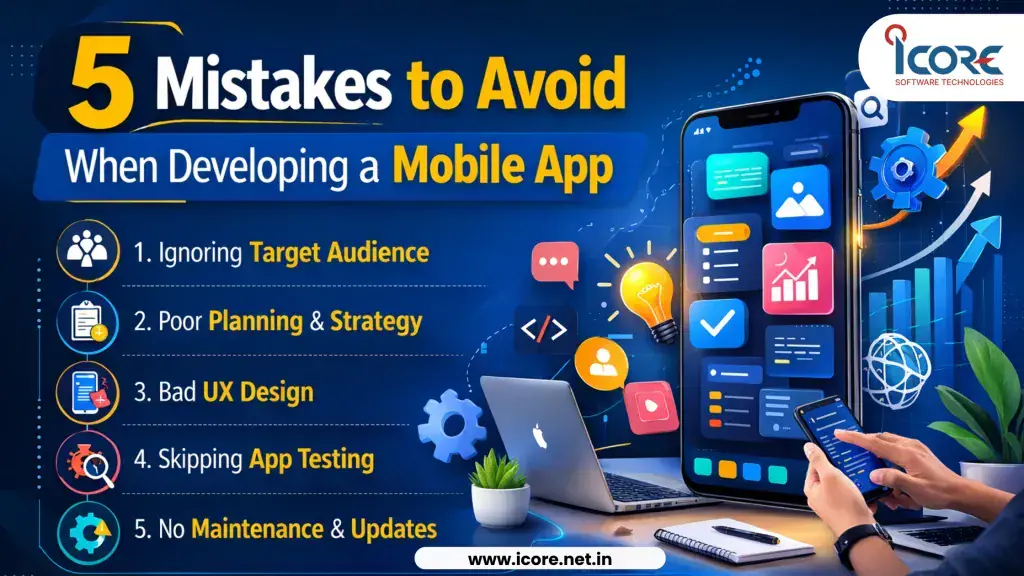
The 5 Mistakes That Sink Mobile App Projects
1. Skipping a proper scoping and discovery phase
Given that unclear requirements discovered mid-build is the most cited cause of budget overruns industry-wide, a short discovery phase that maps every screen, user flow, and integration before development starts is the single highest-leverage thing a business can do to protect its budget.
2. Choosing "build everything" over "build what matters first"
With 48% of projects experiencing scope expansion per PMI's research, businesses that try to launch with every conceivable feature almost guarantee their own scope creep. A tighter first version that does three things well ships faster and costs less than a broad version that does ten things adequately.
3. Picking a technology or vendor based on price alone
A cheaper quote that doesn't account for QA, app store review cycles, and post-launch support is not actually cheaper — those costs typically add 30-40% on top of a development quote regardless of who builds it, so an unusually low bid usually means those costs are hidden, not eliminated.
4. Ignoring the app store review and compliance process
Both Apple and Google reject a meaningful share of first submissions over policy, metadata, or privacy-disclosure issues that have nothing to do with code quality — building in a review buffer of two to three weeks before a target launch date avoids the common trap of promising a "launch date" that's entirely outside your control.
5. Treating launch day as the finish line
Given that large IT projects deliver an average of 56% less value than promised per the McKinsey-Oxford analysis, the gap between "shipped" and "valuable" is usually closed after launch through updates driven by real usage data, not before it. Budgeting zero for post-launch iteration is one of the most common reasons a technically working app never becomes a business asset.
Common Challenges and How to Overcome Them
"We got a quote, but the final bill was way higher."
This is almost always a scoping problem, not a vendor honesty problem. Ask any prospective developer to walk through exactly what's included and excluded in a quote, in writing, before signing anything — and treat a quote with no discovery phase attached as a red flag rather than a bargain.
"Our app launched but nobody's using it."
Check whether the app was built around what customers actually do (book a slot, check stock, track an order) or around what looked impressive in a pitch deck. Usage data collected from day one is what tells you the difference, which is why analytics should never be an afterthought.
"Development is taking much longer than promised."
Ask specifically what changed since the original scope was agreed. If the honest answer is "the requirements grew," that's scope creep, and the fix is to freeze the current version's scope and push new ideas into a clearly labeled version two.
Where Coimbatore Businesses Have an Advantage
- A local development partner can sit across the table for the scoping conversation instead of it happening over email across time zones, which directly reduces the miscommunication that drives a large share of requirement gaps.
- Coimbatore's cost base means a proper discovery phase, QA cycle, and three to six months of post-launch support are affordable inside a realistic total budget, rather than being the first items cut to hit a low headline price.
- Being close to your own customer base makes it easier to test an early version with 15-20 real users before a full public launch, catching usability problems that no amount of internal review would surface.
How Mobile App Development Mistakes Connects with Other Business Strategies
An app that's scoped and built properly still needs a reason for people to open it, which is where it intersects with your broader digital presence — the same clarity that prevents scope creep in development also clarifies what the app should say in its app-store listing, what your wider online presence should promise before someone downloads it, and how support and marketing teams talk about it after launch.
Best Practices for Mobile App Development
- Insist on a written, signed-off scope document before development begins, no matter how small the project.
- Budget 30-40% above the core development quote for QA, compliance, infrastructure, and first-year maintenance.
- Launch with a smaller, well-tested feature set rather than a large one rushed to meet a date.
- Build in analytics from day one so post-launch decisions are based on real usage, not guesses.
- Treat the first three to six months after launch as part of the project, not an optional extra.
FAQs
How long should the scoping phase take before development starts?
For a typical small-to-mid-sized business app, two to three weeks is usually enough to map screens, user flows, and any integrations with existing systems like billing or inventory software.
Is a cheaper app development quote ever a bad sign?
It's worth questioning closely if the quote has no discovery phase, no QA line item, and no mention of app store review time — those costs don't disappear, they just show up later as an unplanned overrun.
Should we build for Android, iOS, or both at once?
That decision should come out of the scoping phase based on where your actual customers are, not a default assumption — building both from day one when your audience is overwhelmingly on one platform is a common source of unnecessary cost.
What's the biggest mistake businesses make after an app launches?
Treating launch as done. The value businesses expect from an app usually comes from a few rounds of improvement based on real usage data, and skipping that step is why some apps never earn back their development cost.
Conclusion
Every one of these five mistakes traces back to the same root cause: decisions made in a hurry, before anyone had a clear enough picture of what the app actually needed to do. The businesses that avoid them aren't necessarily the ones with the biggest budgets — they're the ones that slow down for two or three weeks at the start so they don't lose two or three months at the end.
If you're weighing whether to build an app, or you've already started one that's drifting off budget, it's worth getting a second set of eyes on the scope before committing further spend. Get in touch for a review of your project and a realistic read on what it will actually take to ship something your customers use.
Share it with your colleagues and social network.