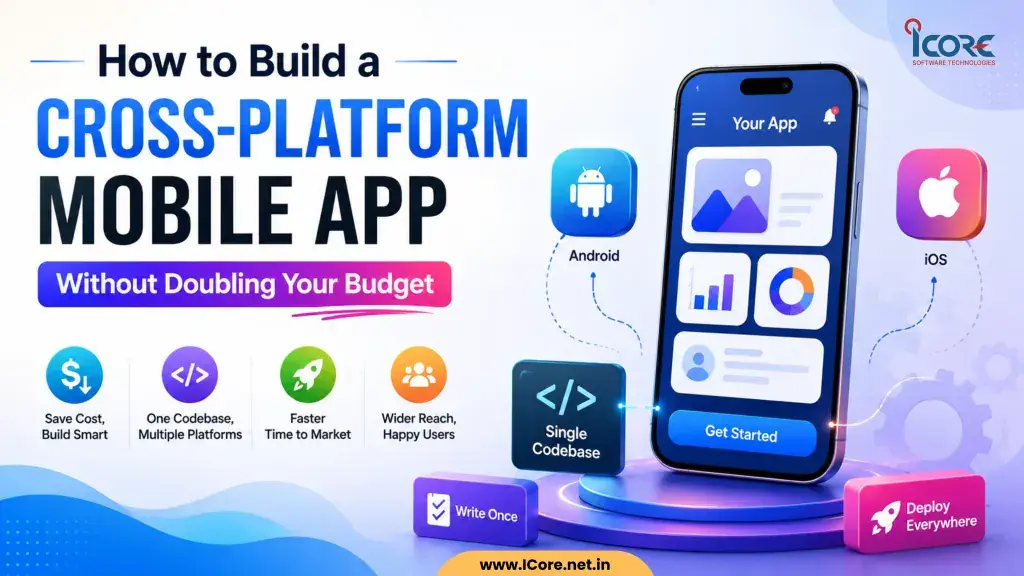
How to Build a Cross-Platform Mobile App Without Doubling Your Budget
Related Insights

Key Takeaways
- •Cross-platform frameworks like Flutter and React Native now deliver near-native performance at roughly 40-60% of the cost of building separate native iOS and Android apps, per 2026 Indian development cost data.
- •A basic cross-platform business app in India typically costs ₹3-8 lakh, while a complex native equivalent can run ₹15-40 lakh or more.
- •Flutter specifically runs about 15-25% cheaper than React Native at equivalent scope in the current Indian market, due to lower platform-bridging overhead.
- •Platform-specific quirks that used to add 15-20% extra development effort to cross-platform builds in 2022 have dropped to just 8-10% in 2026, as both frameworks have matured.
How to Build a Cross-Platform Mobile App Without Doubling Your Budget
A standard business app that costs roughly ₹40 lakh to build with Flutter typically costs ₹60-80 lakh when built as two separate native apps for iOS and Android, according to 2026 Indian app development cost benchmarks. That's not a small difference — it's often the entire remaining marketing budget for the year, spent twice over just to maintain two codebases that do the same thing. For how ICore builds apps, see our Flutter app development and native app service.
Most business owners assume "native app" automatically means "better app," and that cross-platform development is a compromise. In 2026, that assumption is mostly outdated. Here's what cross-platform development actually costs in India right now, and how to use it to get a real app on both platforms without the double-build price tag.
Key Takeaways
- Cross-platform frameworks like Flutter and React Native now deliver near-native performance at roughly 40-60% of the cost of building separate native iOS and Android apps, per 2026 Indian development cost data.
- A basic cross-platform business app in India typically costs ₹3-8 lakh, while a complex native equivalent can run ₹15-40 lakh or more.
- Flutter specifically runs about 15-25% cheaper than React Native at equivalent scope in the current Indian market, due to lower platform-bridging overhead.
- Platform-specific quirks that used to add 15-20% extra development effort to cross-platform builds in 2022 have dropped to just 8-10% in 2026, as both frameworks have matured.
What "Cross-Platform Mobile App Development" Actually Means
Cross-platform development means writing your app's code once, using a framework like Flutter or React Native, and deploying it to both iOS and Android from that single codebase — instead of hiring separate teams to write completely different code in Swift for iPhone and Kotlin for Android. The frameworks handle translating your one codebase into something that runs natively on each platform's operating system.
The old objection to this approach was performance and feel — cross-platform apps used to feel noticeably less smooth than true native apps. That gap has narrowed dramatically; for the large majority of business apps (booking systems, e-commerce, service apps, internal tools), users can't tell the difference, and the frameworks now handle platform-specific quirks with far less manual workaround effort than they did even a few years ago.
What It Looks Like When It's Working
Scenario: A Coimbatore-based logistics company wanted a driver-tracking and delivery-confirmation app for both their Android-heavy driver fleet and an iOS app for client-facing order tracking. An initial quote for separate native builds came in at ₹38 lakh with a 9-month timeline, which was well beyond what the business had budgeted for a first version.
They switched to a Flutter-based cross-platform build instead, which came in at roughly ₹14 lakh and launched in just under 4 months. The app covered both platforms from one codebase, and the company used the roughly ₹24 lakh saved to fund a second version six months later with route optimization features — something that wouldn't have been financially possible if the entire initial budget had gone into two separate native builds. Driver adoption hit 90% within the first month, largely because the app simply worked reliably on whatever phone each driver already carried.
How to Build a Cross-Platform App on a Realistic Budget
Start by defining your actual minimum feature set
The single biggest cost driver in any app project isn't the framework choice, it's scope — a tightly defined first version focused on the 3-4 features your business genuinely needs launches faster and cheaper than an ambitious feature list that delays release for months.
Choose Flutter for most new business apps
Flutter currently runs roughly 15-25% cheaper than React Native at comparable scope in the Indian market and has lower platform-bridging overhead, making it the more cost-efficient default choice for most standard business app types in 2026.
Avoid over-customizing platform-specific UI unless it's essential
Trying to make your app pixel-perfect to each platform's specific design conventions is exactly the kind of work that reintroduces the cost and complexity cross-platform development is meant to avoid; a clean, consistent design across both platforms is usually the better trade-off.
Build a working version before adding integrations
Payment gateways, third-party APIs, and advanced analytics all add real cost and testing time; launch a core working app first, gather real usage data, then add integrations based on what users actually need rather than guessing upfront.
Get a fixed-scope quote, not just an hourly estimate
Open-ended hourly billing on app projects tends to expand well past initial estimates as requirements get clarified mid-build; a fixed price tied to a clearly documented feature list protects your budget from scope creep.
Test on real mid-range Android devices, not just the newest iPhone
Since most cross-platform frameworks now handle platform quirks with far less manual effort than a few years back, remaining performance issues usually show up specifically on lower-end Android hardware — test there directly rather than assuming a good experience on a flagship device translates evenly.
Plan your maintenance budget from day one
Operating system updates on both platforms happen multiple times a year, and a cross-platform app still needs periodic maintenance to stay compatible; budget for this ongoing cost rather than treating the initial build as a one-time expense.
Native vs Cross-Platform Cost Comparison (India, 2026)
| Build Type | Typical Cost Range | Typical Timeline |
|---|---|---|
| Basic cross-platform app | ₹3-8 lakh | 2-4 months |
| Complex native app (single platform) | ₹15-40 lakh | 6-9 months |
| Complex native app (both platforms, separately) | ₹30-80 lakh | 9-14 months |
Common Challenges and How to Overcome Them
"We were told cross-platform apps feel noticeably worse than native."
That was a fair concern several years ago, but the performance gap has narrowed enough that for most standard business app categories, users genuinely can't tell the difference — the remaining edge cases are highly graphics-intensive apps like advanced games, which is a small minority of business use cases.
"Our developer quoted a fixed price that then grew significantly mid-project."
This usually means the original scope document wasn't detailed enough; insist on a written feature list with explicit exclusions before the build starts, so anything added later is clearly a change order, not scope creep hidden inside the original price.
"We built an MVP cheaply but now scaling it up is expensive."
This is common when the initial build cuts corners on the underlying code architecture, not just the feature list; ask upfront whether the codebase is being built to scale or just to launch, since the two require different upfront decisions even at MVP stage.
Where Coimbatore Businesses Have an Advantage
- Access to skilled cross-platform developers at meaningfully lower rates than metro-city agencies, without a real quality trade-off given how standardized Flutter and React Native workflows have become.
- Most local business apps (service booking, delivery tracking, simple e-commerce) fall squarely into the category where cross-platform frameworks perform indistinguishably from native, making the cost savings essentially free upside.
How Cross-Platform Development Connects with Other Digital Strategies
An app rarely succeeds in isolation from the rest of a business's digital presence — the budget saved by building cross-platform instead of dual-native often gets reinvested into a properly optimized website or paid acquisition to actually drive app downloads, since even a well-built app generates little value without a plan to get it into customers' hands.
Best Practices for Cross-Platform App Development
- Define a tightly scoped minimum feature set before requesting quotes from any developer or agency.
- Default to Flutter for most standard business app categories given its current cost advantage.
- Get a fixed-scope, written quote rather than open-ended hourly billing.
- Test thoroughly on real mid-range Android devices, not just flagship phones.
- Budget for ongoing maintenance and OS-update compatibility from the start, not as an afterthought.
FAQs
Is a cross-platform app good enough for a serious business, or only for simple MVPs?
For the large majority of business app categories — booking, e-commerce, service, and internal tools — cross-platform apps are genuinely production-grade in 2026, not just a placeholder MVP option; the remaining gap mainly affects highly graphics-intensive apps like advanced games.
Should I choose Flutter or React Native for my business app?
Flutter is generally the more cost-efficient default in the current Indian market, running roughly 15-25% cheaper than React Native at comparable scope, though React Native remains a strong choice if your team already has React/JavaScript expertise in-house.
How much should a basic business app cost in India in 2026?
A basic cross-platform app typically runs ₹3-8 lakh, while a more complex app with custom integrations costs more depending on scope and complexity. ICore cross-platform apps start from ₹3 lakh.
Can I upgrade a cross-platform app to native later if I need to?
In most cases you don't need to — the performance gap that used to justify switching to native has narrowed enough that businesses more commonly add features to their existing cross-platform codebase rather than rebuilding natively.
Conclusion
Cross-platform development in 2026 isn't the compromise it used to be — for most business apps, it delivers a genuinely comparable user experience at a fraction of the cost of building and maintaining two separate native codebases. The money saved isn't just a nice bonus; it's often the difference between shipping a real first version and not shipping at all.
If you're weighing your options for a new app and want a realistic scope and budget for your specific idea, get in touch for a review.
Planning an app? ICore is a mobile app development company in Coimbatore building native, hybrid and cross-platform apps for Android and iOS, from ₹3 lakh.
Share it with your colleagues and social network.