
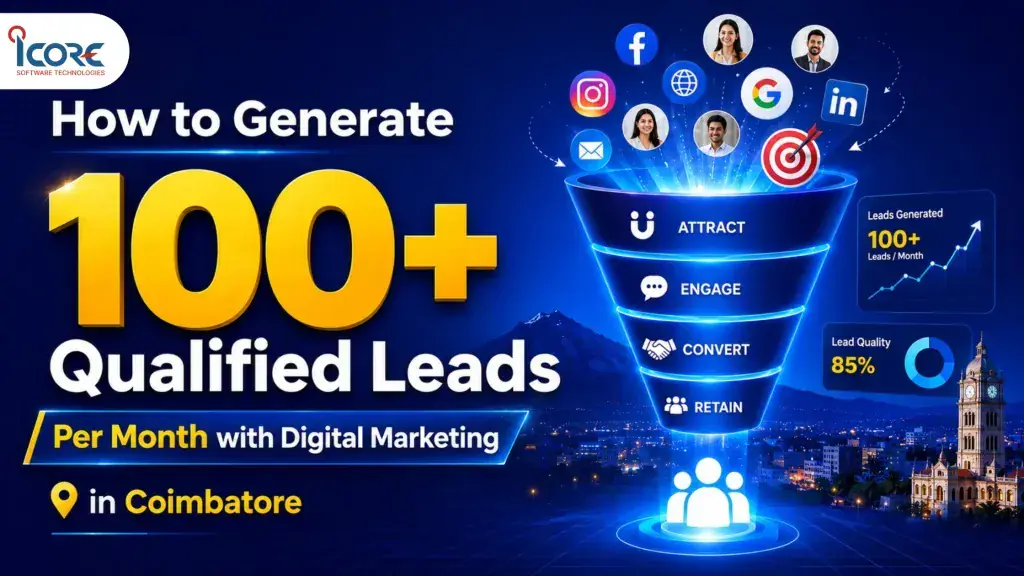
How to Generate 100+ Qualified Leads Per Month with Digital Marketing
Related Insights
How to Use Geo Marketing to Enhance Your Conversions
How to Take Your Business Online Successfully in 2026
9 Mistakes Small Brands Make with Facebook Ads
Key Takeaways
- •Median B2B website conversion rate is 2.9%, but this varies sharply by channel: organic search converts around 2.6%, email around 2.4%, paid search around 1.5%, and paid social around 0.9%.
- •Traffic arriving from AI search tools like ChatGPT and Perplexity now converts at roughly 3.49%, about 22% higher than traditional organic search traffic.
- •Median MQL-to-SQL conversion has fallen from 13% in 2024 to 9.8% in 2026, meaning lead quality now matters more than raw lead volume for hitting real sales targets.
- •Average Google Ads CPC in India runs roughly ₹25-60 across most industries, with local services and education often as low as ₹5-50 and legal, insurance, or finance running ₹1,500-3,000+.
- •Email marketing returns roughly ₹36-42 for every ₹1 spent on average, making a well-managed list one of the highest-ROI channels available for topping up lead volume.
- •The median landing page conversion rate across industries is around 4.3%, but dedicated lead-gen pages for local services can reach 8.5% when built specifically for one offer.
How to Generate 100+ Qualified Leads Per Month with Digital Marketing
The median B2B website conversion rate sits at just 2.9%, based on Ruler Analytics' study of over 100 million data points across 14 industries. That means to generate 100 qualified leads a month from your website alone, you'd need roughly 3,450 relevant visitors reaching that site every month, converting at a typical rate. Most small businesses never get close to that traffic volume through one channel, which is exactly why 100+ leads a month is a multi-channel math problem, not a single-tactic one.
The businesses that consistently hit three-figure monthly lead counts aren't doing one thing exceptionally well. They're running two or three channels at a solid, unremarkable level and stacking the results. This is a practical breakdown of the actual funnel math involved, and the channel mix that gets small and mid-sized businesses there without an enterprise budget.
Key Takeaways
- Median B2B website conversion rate is 2.9%, but this varies sharply by channel: organic search converts around 2.6%, email around 2.4%, paid search around 1.5%, and paid social around 0.9%.
- Traffic arriving from AI search tools like ChatGPT and Perplexity now converts at roughly 3.49%, about 22% higher than traditional organic search traffic.
- Median MQL-to-SQL conversion has fallen from 13% in 2024 to 9.8% in 2026, meaning lead quality now matters more than raw lead volume for hitting real sales targets.
- Average Google Ads CPC in India runs roughly ₹25-60 across most industries, with local services and education often as low as ₹5-50 and legal, insurance, or finance running ₹1,500-3,000+.
- Email marketing returns roughly ₹36-42 for every ₹1 spent on average, making a well-managed list one of the highest-ROI channels available for topping up lead volume.
- The median landing page conversion rate across industries is around 4.3%, but dedicated lead-gen pages for local services can reach 8.5% when built specifically for one offer.
What "Generating 100+ Qualified Leads a Month" Actually Means
A qualified lead isn't just a form fill or a phone number. It's a contact that fits your actual customer profile and has shown real intent, not a random visitor who bounced off a pop-up. Chasing raw lead volume without qualification is why MQL-to-SQL conversion has fallen to under 10% industry-wide: businesses are generating more contacts but fewer of them are sales-ready. Hitting 100+ qualified leads a month means building a funnel where each stage filters for fit, not just building a wider top of funnel.
What It Looks Like When It's Working
Scenario: A Coimbatore B2B industrial equipment supplier was generating around 25-30 leads a month, mostly from word-of-mouth and a handful of directory listings, with roughly half turning out to be unqualified (wrong location, wrong budget, students doing research). They built three parallel channels over four months: a Google Ads campaign targeting high-intent search terms at an average ₹45 CPC and a ₹60,000 monthly budget, an SEO push around their core service pages, and a monthly email newsletter to their existing 2,000-contact list.
By month five, Google Ads alone was converting at roughly 4% on a dedicated landing page (in line with the 8.5% ceiling typical of well-optimized local-service pages, though theirs ran a bit lower given the price point), delivering about 45-50 leads a month from roughly 1,300 monthly clicks. Organic search added another 25-30 as rankings improved, and the email list, now segmented and sent biweekly, contributed 15-20 more. Combined, monthly qualified leads rose from around 15 (after removing unqualified contacts) to a consistent 100-120, with cost per qualified lead actually falling as the channels matured and reinforced each other.
The Channel Mix That Gets You to 100+ Qualified Leads a Month
Start with the funnel math, not the tactics
Work backward from your target: if your best-performing landing page converts at 4-5%, you need roughly 2,000-2,500 qualified visitors a month to reach 100 leads. That number tells you how much traffic you actually need to build across channels, rather than guessing at tactics first.
Treat Google Ads as your fastest, most controllable lever
With Indian CPCs typically running ₹25-60 for most industries (and as low as ₹5-50 for local services), a modest ₹30,000-50,000 monthly budget can realistically generate several hundred clicks, and paid search still converts around 1.5% industry-wide, higher when the landing page and targeting are tight.
Build SEO as the channel that compounds over time
Organic search converts at roughly 2.6%, comparable to or better than most paid channels, and unlike ads, that traffic keeps arriving without ongoing spend once content ranks. It's slower to build but becomes your cheapest lead source within six to twelve months.
Use email as a low-cost multiplier on traffic you already have
At roughly ₹36-42 returned per ₹1 spent, email consistently outperforms most paid channels on pure ROI, and it works on contacts you've already earned through other channels rather than requiring fresh spend to reach them.
Build one landing page per offer, not one page for everything
Dedicated lead-gen pages for a specific offer regularly outperform general homepage or contact-page conversion rates, with local-service lead pages reaching 8.5% versus a 4.3% median across mixed-purpose pages. A single focused offer with one clear form beats a page trying to serve every visitor.
Don't ignore AI search referral traffic
Traffic now arriving from ChatGPT, Perplexity, and similar tools converts at around 3.49%, roughly 22% higher than traditional organic search, which means the content written to answer specific questions clearly (not just to rank for keywords) is starting to pay off through a genuinely new channel.
Qualify before you count, not after
With MQL-to-SQL conversion industry-wide down to 9.8%, build a qualifying question or two into every form (budget range, timeline, specific need) so you're tracking real qualified leads from day one, not inflating a raw contact count that sales will reject later.
Review cost per qualified lead monthly, by channel
Top-quartile demand-gen teams convert MQL-to-SQL at more than twice the median rate while paying roughly half the cost per lead of average teams, and that gap comes almost entirely from ruthlessly reviewing which channels and campaigns actually produce sales-ready contacts, then reallocating budget toward them.
| Channel | Typical conversion rate | Best role in the funnel |
|---|---|---|
| Organic search (SEO) | ~2.6% | Compounding, lowest long-term cost per lead |
| Email marketing | ~2.4% | Low-cost multiplier on existing contacts |
| Google Ads (paid search) | ~1.5% | Fastest, most controllable volume lever |
| Paid social | ~0.9% | Awareness and retargeting support, not primary volume |
| AI search referral | ~3.49% | Emerging, high-intent, low competition currently |
Common Challenges and How to Overcome Them
"We're getting leads but sales says most of them are junk."
This is a qualification problem, not a volume problem. Add a budget or timeline question to your forms and route unqualified contacts differently, so your reported lead count reflects reality. See our breakdown on avoiding common Google Ads campaign mistakes for how targeting fixes filter this upstream.
"One channel worked great for a while, then leads dried up."
Single-channel dependency is fragile against algorithm changes, seasonal shifts, or rising costs. The businesses hitting 100+ consistently run at least two or three channels in parallel specifically so no single channel's dip sinks the whole month.
"We don't have the budget to run ads and SEO and email all at once."
Sequence it rather than launching everything simultaneously. Start with the channel that fits your current budget and timeline (often email, since it uses contacts you already have, per our guide on getting leads from email marketing), then layer in paid and organic as each proves itself.
Where Coimbatore Businesses Have an Advantage
- Lower average CPCs in tier-2 city and regional targeting compared to hyper-competitive metro keyword auctions stretch a modest ad budget further.
- Local SEO competition is generally thinner than in Bangalore, Chennai, or Mumbai, so ranking for high-intent local terms happens faster with less content investment.
- A smaller, more reachable customer base makes direct relationship-building (events, local partnerships, referral programs) a genuinely viable supplementary lead channel, not just a nice-to-have.
How Lead Generation Connects with Other Marketing Strategies
None of these channels work as well in isolation as they do combined. SEO content gets repurposed into email newsletters and social posts, paid ads point to the same optimized landing pages that organic traffic converts on, and email nurtures leads that ads and SEO generated but that weren't ready to buy immediately. The 100+ leads a month figure is really a sign that these channels are reinforcing each other rather than running as separate, disconnected efforts.
Best Practices for Generating Qualified Leads
- Work backward from your lead target to the traffic volume you actually need, per channel.
- Run at least two channels in parallel so no single channel's dip stalls your pipeline.
- Build dedicated landing pages per offer instead of routing all traffic to one general page.
- Add qualifying questions to every form so your lead count reflects sales-ready contacts.
- Review cost per qualified lead by channel monthly and reallocate toward what's actually converting.
FAQs
What's a realistic timeline to reach 100+ leads a month?
With paid channels running alongside SEO, most small and mid-sized businesses see meaningful volume within three to four months, with SEO's contribution continuing to grow well past that point as rankings mature.
Which channel gives the fastest results?
Paid search (Google Ads) typically produces measurable leads within weeks, since it doesn't depend on rankings building over time, making it the usual starting point when speed matters more than long-term cost efficiency.
Do we need a big budget to hit 100 leads a month?
Not necessarily. With Indian CPCs often in the ₹25-60 range and email delivering roughly ₹36-42 per ₹1 spent, a modest, well-allocated budget across two or three channels can realistically get there for many local and regional businesses.
How do we know if our leads are actually qualified?
Track MQL-to-SQL conversion specifically, not just raw form fills. If that rate sits well below the roughly 9.8% industry median, the issue is usually upstream targeting or a missing qualifying question, not the sales team.
Conclusion
Generating 100+ qualified leads a month isn't about finding one magic channel. It's funnel math: knowing your conversion rates, running enough of the right traffic through them, and qualifying rigorously enough that the number you report is a number sales can actually use. The businesses that get there build two or three channels that reinforce each other and review the numbers often enough to know what's actually working.
If you want help building a lead-gen system sized to your budget and target, get in touch and we'll map out the channel mix that makes sense for you.
Share it with your colleagues and social network.