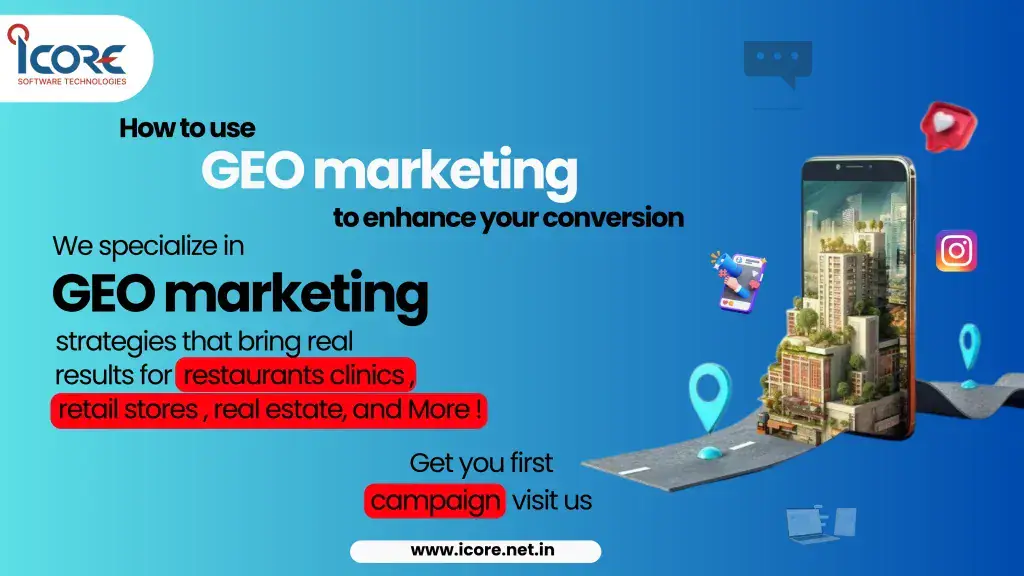
How to Use Geo Marketing to Enhance Your Conversions
Related Insights
How to Take Your Business Online Successfully in 2026
9 Mistakes Small Brands Make with Facebook Ads
Key Takeaways
- •Geofenced campaigns achieve roughly 7.5% average CTR versus 0.9% for average Facebook ads.
- •Geofencing campaigns convert 20-30% higher than non-geotargeted digital campaigns.
- •82% of consumers are more likely to purchase after a location-based offer.
- •Geofenced push notifications see roughly 40% open rates versus ~20% standard.
- •72% of retailers already use geofencing for hyperlocal promotions.
How to Use Geo Marketing to Enhance Your Conversions
Geofenced campaigns see click-through rates around 7.5%, compared to roughly 0.9% for average Facebook ads — more than eight times higher. 82% of consumers say they're more likely to buy after receiving a location-based offer, and 53% have actually visited a store after getting one. If your ads are targeting broad demographics instead of real physical proximity to your business, you're likely leaving one of the highest-converting targeting methods completely untouched.
Key Takeaways
- Geofenced campaigns achieve roughly 7.5% average CTR versus 0.9% for average Facebook ads — more than eight times higher engagement.
- Geofencing campaigns convert 20-30% higher than non-geotargeted digital campaigns, and 90% of marketers report higher sales from location-based marketing.
- 82% of consumers say they're more likely to purchase after a location-based offer, and 53% have visited a business after receiving one.
- Geofenced push notifications see roughly 40% open rates, double the ~20% typical of standard push notifications.
- 72% of retailers already use geofencing for hyperlocal promotions — this is no longer a fringe tactic, it's approaching a standard practice.
What "Geo Marketing" Actually Means
Geo marketing is advertising and messaging targeted by physical location — not just "people in Coimbatore" broadly, but specific radius targeting around your store, a competitor's location, an event venue, or a customer's real-time position. Geofencing is the most common technique: drawing a virtual boundary around a physical location and triggering an ad, notification, or offer when someone with location services enabled enters that zone.
What It Looks Like When It's Working
Scenario: A Coimbatore furniture showroom was running broad Facebook ads targeting "Coimbatore, interested in home decor" with a CTR under 1% and high cost per click. They shifted a portion of budget to a geofenced campaign around their own showroom plus a 3km radius around two competing showrooms, triggering a specific offer to anyone who spent more than a few minutes browsing in those zones.
The geofenced campaign's CTR came in at 6.8%, close to the broader 7.5% benchmark, and in-store visits attributable to the campaign (tracked via a mention-this-offer discount code) accounted for nearly a third of new walk-ins that month — directly reflecting the 53% visit-rate pattern the wider data shows for location-triggered offers.
How to Use Geo Marketing to Boost Conversions
Step 1: Define your geofence zones strategically
Beyond your own store radius, consider fencing high-intent locations — competitor stores, relevant events, complementary businesses whose customers overlap with yours.
Step 2: Time your offers to match real intent
A location trigger alone isn't enough — pair it with timing that matches actual buying moments, like lunch-hour targeting for a restaurant or weekend targeting for a retail showroom.
Step 3: Make the offer specific and location-aware
"10% off if you visit today" performs better than a generic ad, precisely because it acknowledges the person is physically nearby right now — that immediacy is what drives the higher conversion rates in the data.
Step 4: Use geofenced push notifications for existing app users or subscribers
If you have an app or SMS list, geofenced push notifications convert roughly double the rate of standard, non-triggered notifications — a high-leverage channel most small businesses underuse.
Step 5: Track in-store visits, not just clicks
Use a specific discount code, a dedicated landing page, or point-of-sale tracking to connect geo-targeted ad exposure to actual store visits and purchases — click data alone understates the real impact.
Step 6: Layer geo-targeting onto your existing campaigns
Rather than building an entirely separate geo campaign, add location radius targeting to your current Google or Meta ads first — it's often a simple setting change with a meaningful performance lift.
Common Challenges and How to Overcome Them
"We're not sure geofencing is worth the added complexity."
Start small — fence just your own store radius for a limited campaign and compare CTR and conversion against your standard ads before expanding to competitor or event-based fencing.
"We can't tell if geo ads are actually driving in-store visits."
Add a trackable element — a unique discount code, a dedicated URL, or a simple "how did you hear about us" prompt at checkout — specifically for the geo campaign.
"Our geofenced ads aren't converting despite good CTR."
Check offer relevance and timing — a generic ad in a geofence underperforms a specific, time-relevant offer, even with the same location targeting.
Where Smaller Businesses Have an Advantage
- A single physical location makes geofence setup simpler and more directly tied to measurable foot traffic than a large multi-location enterprise.
- Local knowledge of nearby competitor locations and complementary businesses makes strategic zone selection easier to do well.
How Geo Marketing Connects with Other Strategies
Geo marketing complements local SEO (a strong Google Business Profile amplifies the credibility of a geo-targeted ad someone sees), works well alongside SMS and app-based marketing for existing customers, and provides genuinely trackable, location-verified data that sharpens broader ad targeting over time.
Best Practices for Geo Marketing
- Fence strategically — your own location, relevant competitors, and high-intent nearby venues, not an arbitrarily large radius.
- Pair location triggers with time-relevant, specific offers rather than generic ad copy.
- Track in-store visits and purchases, not just click-through rate.
- Layer radius targeting onto existing campaigns before building entirely separate geo campaigns.
- Use geofenced push notifications for app users or SMS subscribers where available.
FAQs
Is geofencing only useful for retail businesses with a physical store?
It's strongest for physical-location businesses, but service businesses can also use it — targeting specific neighbourhoods or event venues relevant to their service area.
How large should a geofence radius be?
It depends on the goal — a tight radius (a few hundred meters) works for immediate foot-traffic offers, while a few kilometers suits broader local-intent targeting.
Do I need a large budget to start with geo marketing?
No — radius targeting can often be added to existing Google or Meta ad campaigns as a setting, making it accessible even on a modest budget.
How is geo marketing different from general local SEO?
Local SEO is about organic visibility (Google Business Profile, Maps rankings); geo marketing is paid, real-time targeting based on physical proximity — the two work well together but are distinct tactics.
Conclusion
Geo marketing consistently outperforms broad digital targeting on both engagement and conversion, precisely because it reaches people at the moment and place they're most likely to act. Businesses layering location-based targeting onto their existing campaigns are seeing measurably higher returns than those still relying on broad demographic targeting alone.
If you want help setting up a geo-targeted campaign for your business, get in touch for a straightforward review.
Share it with your colleagues and social network.