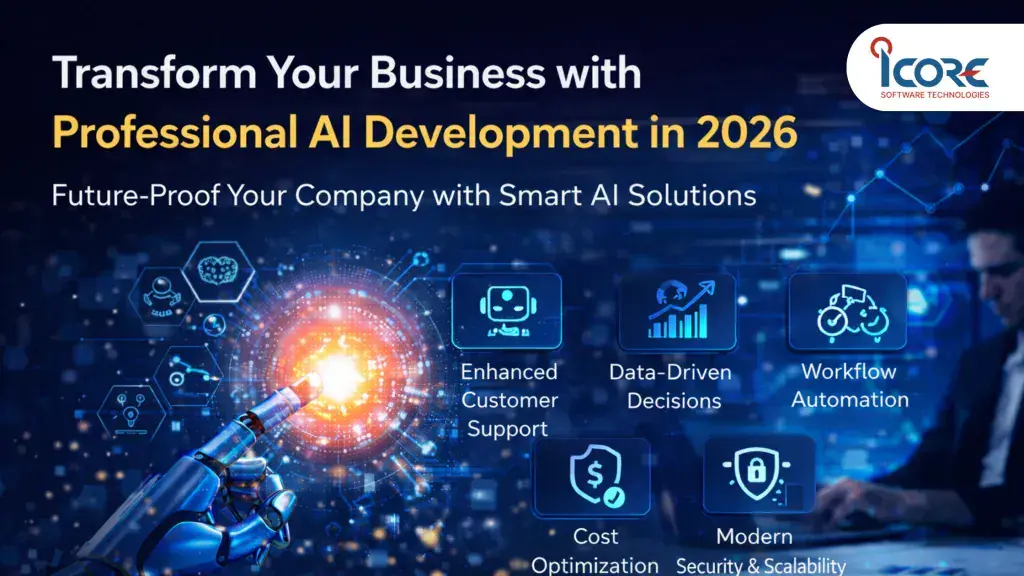
Why Your Business Needs Professional AI Development in 2026
Related Insights


Key Takeaways
- •Small business AI adoption rose from 36% in 2023 to roughly 89% in 2026.
- •AI-using companies report 26-55% productivity gains in the functions where it is deployed.
- •91% of businesses using AI report measurable revenue increases.
- •Trained teams see roughly 2.3x higher productivity than untrained deployments.
- •Average measured ROI on AI tool investment for small businesses runs around 3.7x.
Why Your Business Needs Professional AI Development in 2026
AI adoption among small businesses jumped from 36% in 2023 to roughly 89% by 2026, according to the U.S. Chamber of Commerce's tracking. That's not a trend anymore — it's the baseline. The real question for most business owners now isn't whether to adopt AI, it's whether a bolted-on consumer chatbot is good enough, or whether the gap between that and a properly built AI solution is now costing you the return your competitors are already capturing.
Key Takeaways
- Small business AI adoption rose from 36% in 2023 to roughly 89% in 2026 — adoption alone is no longer a competitive edge, proper implementation is.
- Companies using AI report productivity gains of 26-55% in the specific functions where it's deployed.
- The average business owner or manager saves over 7 hours a week using AI tools; the average employee saves around 5.6 hours weekly.
- 91% of businesses using AI report measurable revenue increases, and AI-using businesses are roughly 2.3x more likely to report revenue growth than non-adopters.
- Training matters more than the tool: businesses that train employees on AI tools see roughly 2.3x higher productivity than those that deploy without training — yet about half of small firms using AI invest nothing in implementation support.
- Average measured ROI on AI tool investment for small businesses runs around 3.7x, per recent industry tracking.
What "Professional AI Development" Actually Means
There's a real difference between subscribing to an off-the-shelf AI tool and having AI properly built into how your business actually operates. Professional AI development means custom-built or properly configured AI — a chatbot trained on your actual product catalog and policies, an automation that connects your CRM, inventory, and support tickets, or a data analysis pipeline tuned to your specific business questions — rather than a generic tool used exactly as it ships out of the box.
What It Looks Like When It's Working
Scenario: A Coimbatore-based distribution business was using a generic customer support chatbot that couldn't answer product-specific questions, frustrating customers into abandoning chats and calling instead — defeating the entire point of automating support. After a properly built AI system trained on their actual product catalog, pricing rules, and order-status data was implemented, first-response resolution rose from roughly 20% to 68%, and their two support staff redirected freed-up time to handling the more complex cases that genuinely needed a human.
The productivity gain matched the broader data closely — support staff reported saving several hours a week on repetitive questions, in line with the 26-55% functional productivity gains reported industry-wide, and the business saw a measurable increase in completed orders from customers who previously abandoned unresolved chats.
How to Approach AI Development for Your Business
Step 1: Identify the highest-friction repetitive task first
Don't start with "we should have AI somewhere." Start with the specific task eating the most staff time on low-complexity, repetitive work — customer FAQs, data entry, report generation, lead qualification — and target that first.
Step 2: Choose build vs. configure based on how specific your workflow is
Generic workflows (basic scheduling, standard email drafting) are well served by configuring an off-the-shelf tool. Anything tied to your specific product catalog, pricing logic, or internal data genuinely needs custom development to be reliable rather than embarrassingly wrong.
Step 3: Budget for training, not just the tool
Given training produces roughly 2.3x the productivity gain of deployment alone, and about half of small businesses skip this step entirely, allocating even a modest training budget is one of the highest-return decisions in an AI project.
Step 4: Start with one function, measure it, then expand
Deploy in the single highest-friction area first, measure the actual time saved and error rate over 4-6 weeks, then use that real data to justify and design the next expansion — rather than a company-wide rollout with no baseline to measure against.
Step 5: Connect AI tools to your real data, not a demo dataset
A chatbot or automation that isn't actually connected to your live inventory, CRM, or order system will eventually give a customer or employee wrong information — which is worse for trust than having no automation at all.
Step 6: Plan for ongoing maintenance, not a one-time build
Products, pricing, and policies change; an AI system trained once and never updated degrades in usefulness over time. Budget for periodic retraining and monitoring, similar to how a website needs ongoing maintenance after launch.
Common Challenges and How to Overcome Them
"We adopted AI tools but haven't seen the productivity gains everyone talks about."
This is almost always a training and integration gap, not a tool-quality problem — the data shows a 2.3x productivity difference between trained and untrained teams using the same tools.
"Our chatbot gives customers wrong or generic answers."
This means it's running on generic training data rather than your actual product and policy information — the fix is proper integration with your real data sources, not a different off-the-shelf tool.
"We're not sure which task to automate first."
Look for the task with the highest volume and lowest complexity per instance — repetitive customer questions and data entry are almost always the highest-return starting points.
Where Smaller Businesses Have an Advantage
- Fewer legacy systems to integrate with, making custom AI development faster and cheaper than for a large enterprise with decades of fragmented software.
- Faster decision-making means a small business can deploy, measure, and iterate on an AI tool in weeks rather than the months a large organization needs for the same rollout.
- Direct owner involvement means training and adoption tends to happen faster, closing the gap that produces the 2.3x productivity difference discussed above.
How AI Development Connects with Other Business Decisions
AI initiatives depend on and strengthen other systems: a well-structured CRM and clean data are prerequisites for AI to be genuinely useful rather than generic; a properly built website or app becomes the interface for AI-powered chat and search; and marketing content increasingly needs to be structured in a way both traditional search engines and AI tools can parse and cite accurately.
Best Practices for AI Development in 2026
- Start with one clearly defined, high-friction task rather than a broad "AI transformation" initiative.
- Budget for training and change management alongside the tool or development cost itself.
- Connect AI systems to real, live business data rather than static or demo datasets.
- Measure time saved and error rate over a defined period before expanding scope.
- Plan for ongoing maintenance and retraining as products, pricing, and policies change.
FAQs
Is off-the-shelf AI enough, or do we need custom development?
Generic workflows are fine with off-the-shelf tools; anything tied to your specific product data, pricing, or policies needs custom development to stay accurate and useful.
How long does an AI development project typically take?
A focused, single-function implementation (like a trained support chatbot) commonly takes four to eight weeks; broader, multi-system integrations take longer.
What's a realistic ROI to expect from AI investment?
Industry tracking suggests an average of around 3.7x return on AI tool investment for small businesses, though this varies significantly by implementation quality and use case.
Do we need to train our whole team, or just the people using the tool directly?
At minimum, train everyone who interacts with the tool directly; the productivity data shows training is one of the highest-leverage parts of any AI rollout.
Conclusion
Professional AI development in 2026 isn't about having AI somewhere in your business — adoption alone stopped being a differentiator once it reached 89% of small businesses. The real advantage now sits with businesses that build AI properly into their actual workflows, train their people on it, and connect it to real data, which is exactly where the productivity and revenue gains in the data above actually come from.
If you're weighing an off-the-shelf tool against a properly built solution for your business, get in touch for a straightforward assessment.
Share it with your colleagues and social network.